
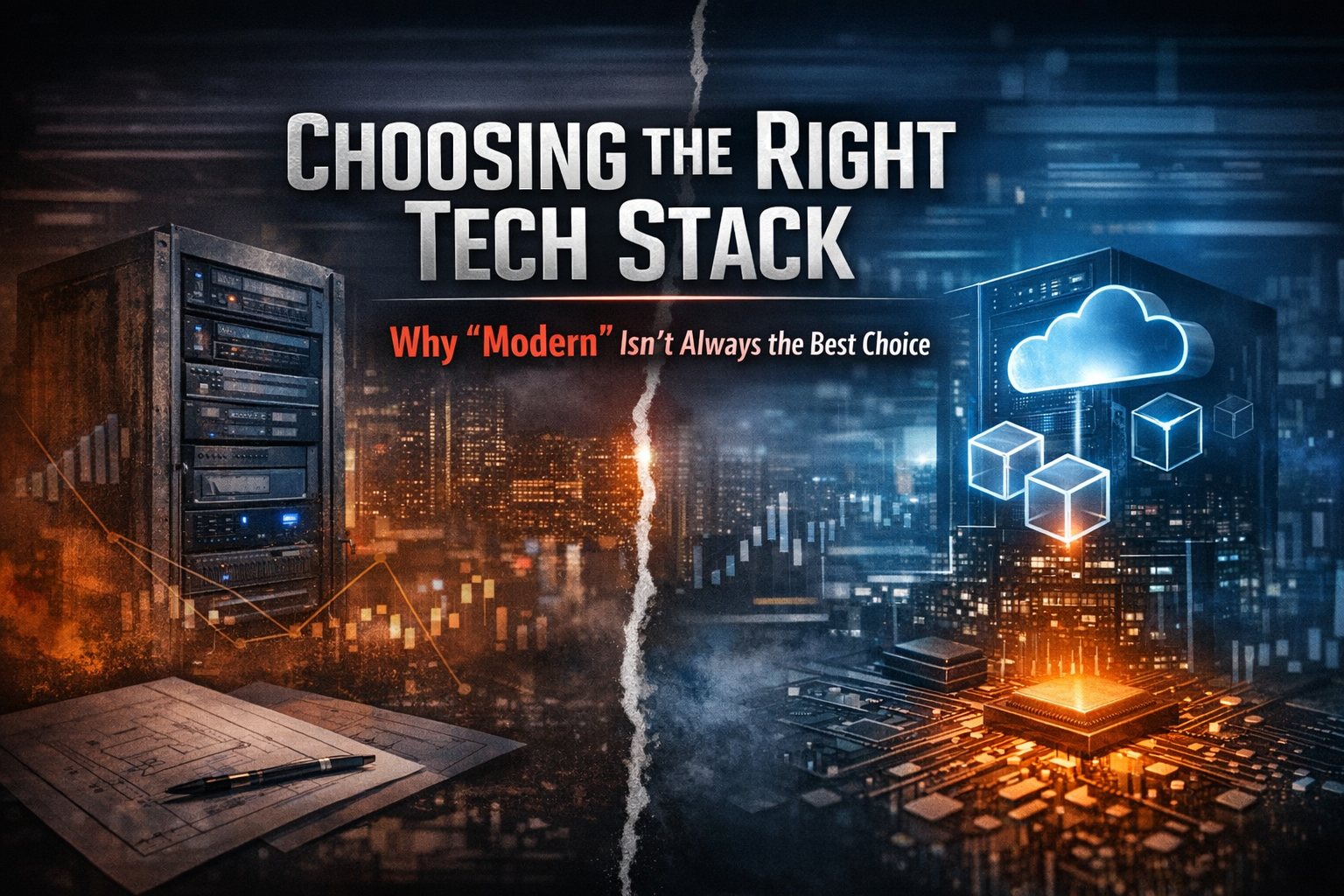
Choosing the Right Tech Stack: Why “Modern” Isn’t Always the Best Choice

Choosing technology is choosing how your business will survive pressure.
The technology industry moves at a brutal pace. New frameworks appear, platforms rebrand themselves as “next-generation,” and every release cycle promises speed, scale, and transformation. In this noise, one dangerous belief has taken root in many organizations:
If the technology is modern, the decision must be right.
That belief is wrong.
Modern technology does not guarantee clarity, stability, or business success. In many cases, it accelerates failure by hiding poor decisions behind polished tooling, complex architectures, and impressive terminology.
Modern Technology Is Not a Strategy
A tech stack is not a symbol of innovation. It is an operational commitment that defines how a business builds, ships, secures, maintains, and evolves its products over years — not weeks.
Choosing technology without anchoring it to business reality produces the same outcomes every time: bloated systems, rising costs, fragile deployments, and teams afraid to touch their own code.
Technology should never lead the conversation. Strategy must come first. Technology exists to serve it — not to replace it.
Context Beats Popularity Every Time
What works for a global technology giant rarely works for a growing business.
Large organizations succeed with complex stacks because they operate with specialized teams, deep budgets, redundancy in skills, and tolerance for failure. Most companies do not have these advantages.
When growing teams copy enterprise-grade architectures or bleeding-edge stacks, they inherit complexity without the capacity to control it. The result is predictable: slow delivery, operational stress, and technical debt disguised as sophistication.
Context — team size, hiring reality, regulatory pressure, budget limits, and operational maturity — matters more than any framework trend.
Overengineering Is Not Future-Proofing
Overengineering is often justified as preparation for growth. In reality, it is fear disguised as foresight.
Systems overloaded with unnecessary abstraction slow teams down, concentrate knowledge in a few individuals, and turn routine changes into risky operations. When those individuals leave, the system becomes a liability instead of an asset.
A system that cannot be understood, modified, and recovered with confidence is not scalable — it is fragile.
Your Team Is Part of the Architecture
A technology decision is only as strong as the people responsible for maintaining it.
If a stack cannot be debugged confidently, cannot be hired for locally, or cannot survive without constant external support, it is not a strategic choice. It is a long-term risk.
Sustainable systems are built with technologies teams can master deeply — not tools they constantly chase.
Maintainability Is the Real Measure of Scale
Most systems do not fail at launch. They fail quietly, years later — when priorities shift, teams change, and quick fixes pile up.
Real scalability is not about handling more users. It is about surviving change without collapse.
If every modification feels dangerous, the system has already failed its purpose.
Watch: How to Choose the Right Tech Stack
Stability, Security, and Responsibility Are Non-Negotiable
Speed without stability creates chaos. Innovation without security creates liability.
For systems that handle real value — data, money, identity, or critical operations — predictability and reliability matter more than novelty.
Security is not something you add later. It is a design decision made at the very beginning.
A Clear Position
At Quantum Vision, technology is never chosen for attention or trend alignment.
Every tool, framework, and platform must justify its existence through measurable business value, operational clarity, and long-term survivability.
Modern tools are welcome — but only when they earn their place.
Final Thought
The right tech stack is rarely the loudest one.
It is the one that supports the business without drama, empowers teams instead of overwhelming them, adapts under pressure, and continues delivering value long after trends fade.
We don’t build for hype.
We build systems that last.